Converge 2026: Why does pacing matter?
Honouring your body’s natural energy envelope.
Brain Fog Note: If your energy is low today, feel free to just read the bold text and bullet points. You can always save the rest for a day when your brain feels clearer.
-
The following series translations reframe the clinical data from the Australian POTS Foundation Converge 2026 conference through a neuroaffirming, trauma-informed lens. As a psychologist, I do not provide medical advice or prescribe treatments; instead, my goal is to help you bridge the gap between complex physiological findings, somatic regulation practices, and systemic well-being.
Critical Note for Readers: The information presented below is for educational and supportive purposes only. For any medical adjustments, targeted diagnostics, or medication plans, please consult a qualified healthcare provider
Welcome to the next installment in our ongoing series where we are sharing key clinical takeaways, research updates, and practical insights from the Australian POTS Foundation Converge Conference.
For individuals navigating complex chronic conditions like Postural Orthostatic Tachycardia Syndrome (POTS), Long COVID, or ME/CFS, fatigue is one of the most misunderstood symptoms. Society constantly tells us to push through, stay motivated, or try harder.
However, the latest research presented at Converge highlights a truth that our community has known intuitively for years: overexertion is not a mindset problem, it is a strict biological boundary.
What Does Pacing Actually Mean?
Before diving into the science, let’s define pacing in plain, practical terms.
The Pacing Rule: Pacing means accurately identifying what your body is capable of doing on any given day —> and intentionally reducing that activity by 10% to 20% so you never hit your absolute max capacity.
A Real-World Example: If you know that you are physically capable of walking for 15 minutes before your body gives out, a pacing strategy means stopping at 10 to 12 minutes.
By stopping before you empty your biological tank, you leave a vital 10–20% energy buffer. This buffer prevents your autonomic nervous system from panicking and triggering a severe symptom crash.
The Science of Post-Exertional Malaise (PEM) Symptoms: Cellular, Not Psychological
A major theme during the fatigue management updates at the conference was a radical, evidence-based validation of this energy envelope.
When you overspend your physical, emotional, or cognitive energy, your body doesn't just feel tired; it experiences a systemic metabolic crash and an adrenaline dump that can take days or weeks to recover from.
Groundbreaking cellular research shows that post-exertional malaise (PEM) and autonomic crashes are driven by distinct vascular, mitochondrial, and metabolic dysfunction:
Real Muscle Abnormalities: A landmark 2024 study published in Nature Communications (Appelman et al.) proved that post-exertional symptoms in Long COVID are caused by actual tissue-level muscle damage and cellular energy failure—not physical deconditioning or bed rest.
Organic Physiological Drivers: Research by leading scientists Dr. Akiko Iwasaki and Dr. David Putrino (published in The Lancet Infectious Diseases) outlines how persistent immune activation and autonomic dysfunction create clear, organic barriers to energy production.
When your cells cannot generate energy efficiently, trying to exercise your way out of it without strict pacing will only trigger deeper system crashes.
The Perimenopause Shift: Hormones and Your Autonomic System
Understanding the biological reality of dysautonomia is especially vital during major life transitions, such as navigating perimenopause in your late 30s, 40s and beyond.
Estrogen and progesterone are not just reproductive hormones; they act as primary regulators of your blood vessels, body temperature, and nervous system stability:
Vascular Tone and Blood Pooling: Estrogen helps maintain the natural tone and flexibility of your blood vessels. As estrogen levels begin to fluctuate wildly during perimenopause, blood vessels struggle to constrict properly when standing. This amplifies abdominal blood pooling and forces your heart rate to spike much harder to pump blood back to your brain.
The Loss of the Calming Brake: Progesterone acts as a natural neurosteroid that calms the central nervous system. As progesterone drops, the nervous system loses its natural buffer against adrenaline, making hyperadrenergic POTS spikes and anxiety-like physical symptoms far more frequent.
Hot Flashes as Adrenaline Surges: Vasomotor symptoms like hot flashes or night sweats are not just temperature glitches —> they are sudden surges of the sympathetic (fight-or-flight) nervous system. These night-time adrenaline dumps disrupt deep, restorative sleep, draining your energy envelope before your feet even touch the floor in the morning.
Validating these physical shifts helps remove the shame. You aren't losing the gains you have made in your physical health or failing at self-care; your autonomic operating system is managing a significant hormonal shift that requires extra structural support, on top of your chronic illness.
I know this may sound bleak, but there is always a twist of hope - this is where nervous system support and somatic regulation can help scaffold you.
Somatic Regulation: Shifting Away from the “Shoulds”
In somatic therapy, we treat your daily energy capacity (your spoons) as a literal prescription for safety, not a measure of your worth.
Pacing is the intentional, data-driven practice of staying within your energy boundaries so your nervous system doesn't have to trigger a panic-driven adrenaline surge just to get you through the day.
Releasing the "should mountain" (that internal pile of expectations about what you think you ought to be doing) is a profound act of nervous system care just on its own.
Somatically, we practice permission to adapt:
Sit Down for Daily Tasks: Brush your teeth, shower, or chop vegetables while seated on a stool to remove upright gravity strain on your heart rate and vascular system.
Alternate Task Types: Switch between physical chores and mental tasks to give different neurological pathways a rest throughout the day.
Adapt Your Work and Home Environment: Use pacing tools, delegate household demands, and integrate regular horizontal resting breaks without guilt. Preserving your nervous system's baseline is always the top priority.
Objective Tracking: Meet the Free Visible App
One of the most exciting tools presented at the Converge conference was Visible, a digital activity and pacing tracker designed specifically for complex chronic illness.
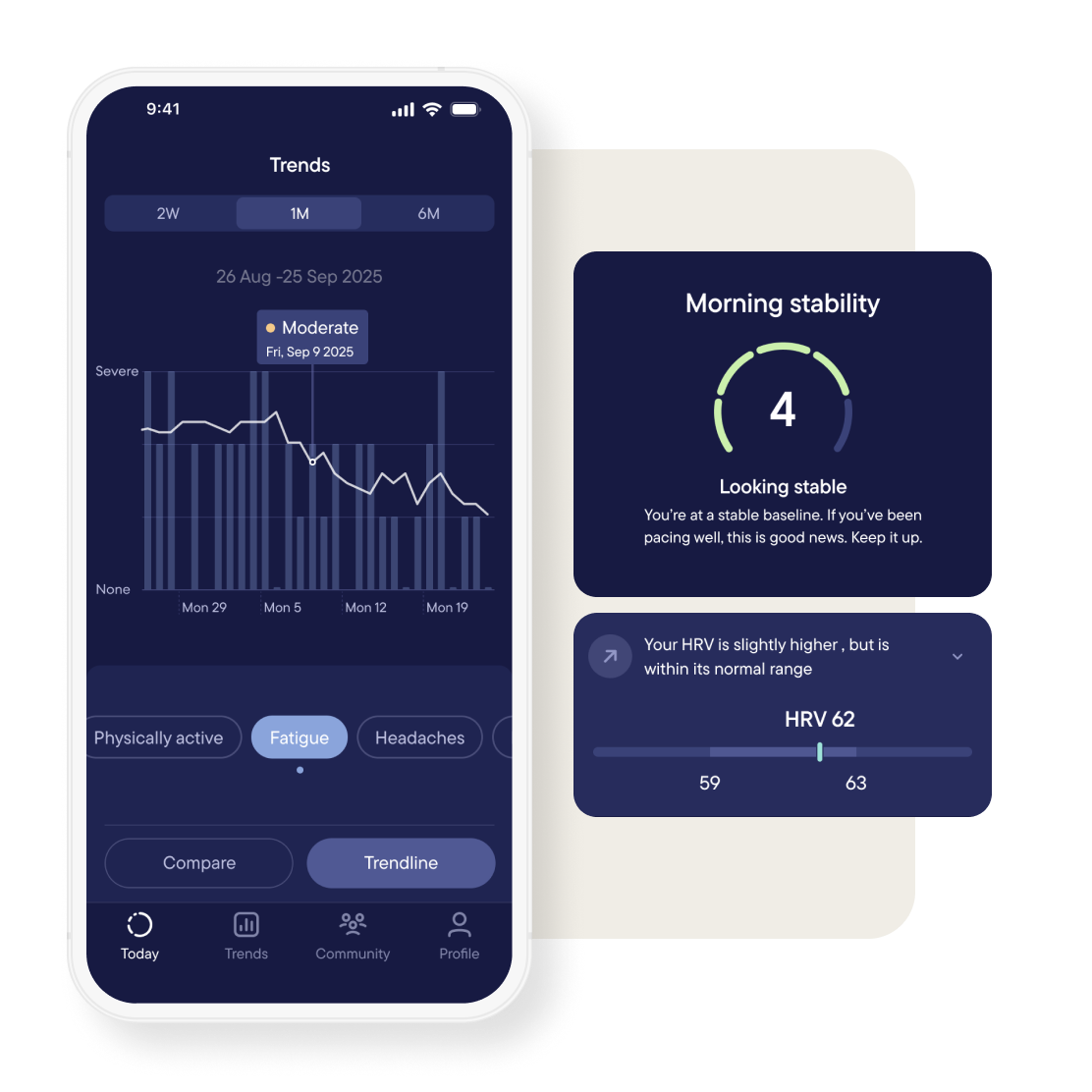
Created by Harry Leeming in collaboration with leading dysautonomia researcher Dr. David Putrino and his team at Mount Sinai’s Cohen Center for Recovery from Complex Chronic Illness
Why Simple Tracking Complements Your Care:
It is Completely Free: You don't need an expensive smartwatch. The free version uses your smartphone camera to measure your Heart Rate Variability (HRV) and resting heart rate each morning.
Objective Data for Your Care Team: It translates internal physical strain into a simple daily "Stability Score." This gives you hard data to bring to your doctors, specialists, and physical therapists, removing the burden of trying to prove your fatigue or flares.
Complements Mind-Body Work: Psychological and somatic tools help you process the emotional weight of illness, while biometric tracking gives you an early warning system before a crash happens. Together, they build a complete, supportive framework for autonomic health.
Clinical References & Key Studies
Muscle Damage & PEM: Appelman, B., et al. (2024). Muscle abnormalities worsen after post-exertional malaise in long COVID.Nature Communications, 15, Article 17.
Physiological Drivers of Fatigue: Iwasaki, A., & Putrino, D. (2023). Why we need a deeper understanding of the pathophysiology of long COVID.The Lancet Infectious Diseases, 23(4), 393-395.
Pacing & HRV Tracking: Learn more about the research studies and download the free pacing platform directly at Visible (makevisible.com).
Honour Your Body's Intelligence
Learning to live within your energy envelope isn't about giving up; it's about giving your nervous system the stability it needs to navigate changing hormonal seasons smoothly.
Explore the Community Hub: Visit our POTS and Somatic Resource Hub to download pacing toolkits, environmental checklists, and symptom tracking sheets.
Work With Us: If you want guidance on integrating somatic pacing strategies into your daily life, Get in touch to get started.