Why Does Spring Trigger POTS and Autonomic Flares?
Navigating Weather Triggers, Heat, and Seasonal Shifts
Spring in Australia brings longer days, blooming flowers and, for many of us living with dysautonomia, an abrupt downward slide in physical capacity.
With El Niño officially confirmed in June 2026, this season brings an added layer of challenge: earlier heat spikes, dry winds, and rapid atmospheric shifts across the country.
If you’ve noticed your heart rate spiking, your brain fog worsening, or a sudden wave of fatigue hitting as the weather warms up, you are not imagining it.
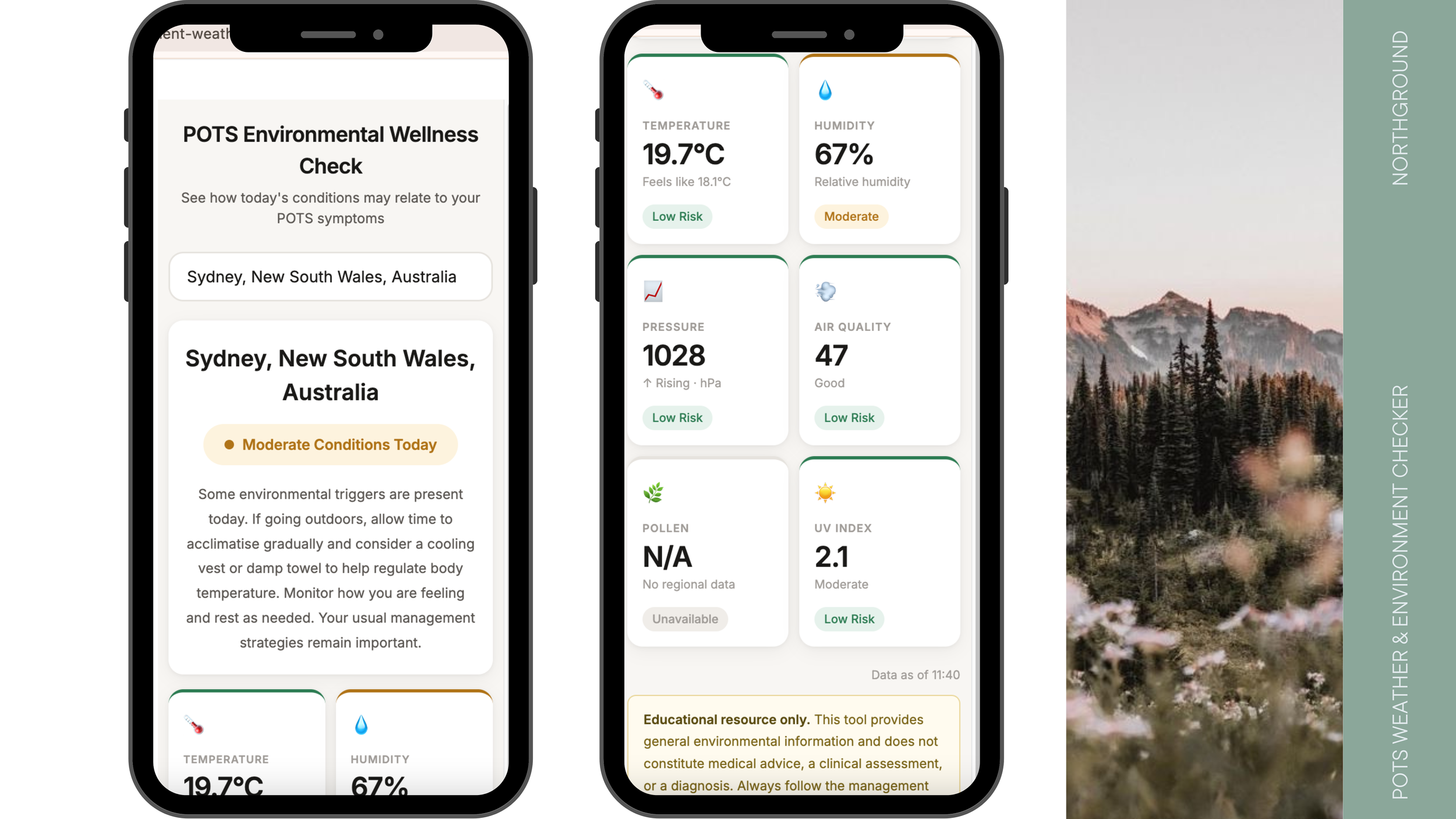
To help you track these invisible environmental shifts in real time, you can check your daily risk score using our POTS Environment & Weather Checker:
Why Transitional Months Trigger Symptom Slides
It isn’t just extreme heat or high pollen that causes flares; it is the volatility of transitional months. Autumn-to-Winter and Winter-to-Spring force our autonomic nervous systems to work over-time to maintain homeostasis.
During seasonal transitions, your body is constantly recalculating how to regulate core temperature, blood vessel tone, and fluid balance. This baseline atmospheric friction uses up significant nervous system energy; leaving far less capacity for your daily life.
My Four-Seasons Rhythm
A Lived Experience with Dysautonomia
Through my own health journey with dysautonomia, I’ve had to rewrite my relationship with the changing seasons following a lifelong love of the spring and warm weather. There is grief that comes with now dreading the seasons which used to be my favourite.
But as dear friend loves to say to me, “there is always a twist of hope” - and indeed I have now come to understand there is a broad pattern to weather changes and dysautonomia.
Recognising these macro-patterns has helped me stop treating every weather-induced dip as either a personal failure or going back to square one health-wise:
Autumn —> Leaving the red zone
As the harsh summer heat breaks, my system finally steps out of crisis mode. Vasodilation eases, and I begin to feel my baseline return.
Winter —> Filling the bucket
Cooler weather is my time to build reserves. I use the crisp air to move more, restore nervous system capacity, and quietly push myself back into the green.
Spring —> Pacing and day-by-day awareness
Spring is about navigating an increase in environmental triggers. I take every day as it comes, actively monitoring barometric drops, rising pollen, and unexpected warm days.
Summer —> “Just keep swimming”
Summer is simply making it through and prioritising rest and cool environments. This can be where symptoms become very uncomfortable with regular crashes. On the hottest days, my inner mantra becomes: "I am having symptoms, but I am safe." I focus on staying cool and trusting that all the capacity-building and tending I did in the cooler months is still under the surface, waiting to greet me again when Autumn arrives.
A Flare Is Not a Relapse
When an environmental shift hits and your symptoms surge, your brain’s threat detection system naturally rings alarm bells. It is easy to slide into catastrophic thinking:
"I’ve relapsed." "All my hard work to nurture, scaffold, and pace is completely gone."
This is not true. A seasonal flare is not a setback in your healing; it is an increased environmental load on an already sensitive system.
Your capacity building, your strength, and your nervous system work haven't disappeared. They are simply working behind the scenes to buffer an environment that has suddenly become much harder to navigate. The foundation you built, is still holding you up even if it feels like you are currently standing in a storm.
Taking Care of Yourself Through Spring

When spring conditions threaten to push you into a crash, pivot from capacity building to active preservation:
Check the External Risk: Use our POTS Environment & Weather Checker each morning to see if temperature, pollen, or pressure are in the yellow or red zone.
Pre-emptive Hydration & Salt: On high-pollen or high-humidity days, increase your fluids and electrolytes early in the morning before vasodilation sets in.
Use Somatic Anchors: Physical symptoms can trigger psychological health anxiety, which further activates the sympathetic nervous system. Explore our Somatic Regulation Masterguide for grounding techniques designed to down-regulate your system during a flare.
Lower the Pacing Bar: If the environmental risk is high, cut your planned non-essential tasks by half. Let your body use its energy for thermoregulation rather than pushing through productivity goals.
Remember:
the impact of weather on how you feel is temporary. It is a season, not a permanent state. Tend to your body with patience, rely on your scaffolding, and trust the resilience you’ve built.
If seasonal weather shifts are leaving you feeling overwhelmed or worried you've lost your progress, reach out to us to build a personalised pacing and somatic framework that supports your nervous system through every season.