When the volume is stuck on 10

Why Your Nervous System is the Key to Chronic Pain
If you live with a chronic illness like Fibromyalgia, POTS, EDS, MCAS or Long COVID, you are likely intimately acquainted with pain. But you are also likely acquainted with the frustration of clear scans and blood tests that say everything is normal while your body feels like it’s under siege.
At Northground, we look at pain through a different lens. We don’t just look at the tissues; we look at the operating system—the nervous system.
Pain is a Protector, Not Just a Sensor
We often think of pain like a direct wire: you stub your toe, the signal travels to the brain, and you feel pain. But chronic pain is different. It’s less about a broken part and more about an alarm system that has forgotten how to turn off.
When you have been ill for a long time, your nervous system enters a state of Central Sensitisation. Your brain becomes hyper-vigilant, scanning for threats. Because it wants to keep you safe, it begins to interpret even normal signals (like a change in barometric pressure, a stressful email, or a slight digestive shift) as high-level danger.
The Neuro-Somatic Loop
In conditions like POTS or Fibromyalgia, the Insular Cortex—the part of your brain that monitors your internal state—can become loud.
The Body: Sends a signal (e.g., "I'm tired" or "My heart is fast").
The Brain: Interprets this through a lens of past flares and trauma.
The Response: The brain turns up the volume, creating the sensation of pain to force you to stop and protect yourself.
This creates a loop: Pain leads to stress, stress tightens the nervous system, and a tight nervous system creates more pain.
How Somatic Therapy Changes the Channel
Traditional talk therapy works from the top-down (using thoughts to change feelings). Somatic therapy works from the bottom-up. Instead of trying to talk your brain out of feeling pain, we use the body to signal safety to the brainstem.
By using techniques like EFT (Tapping), Somatic Tracking, and Vagal Toning, we are effectively teaching your Alarm System that it can stand down. We aren't ignoring the pain; we are changing the brain’s relationship to the signal.
What to do during a Pain Flare: 4 Somatic Strategies
When you are in the middle of a flare, your system is Red-Lining. The goal isn't to fix the illness in that moment; it is to lower the baseline of threat.
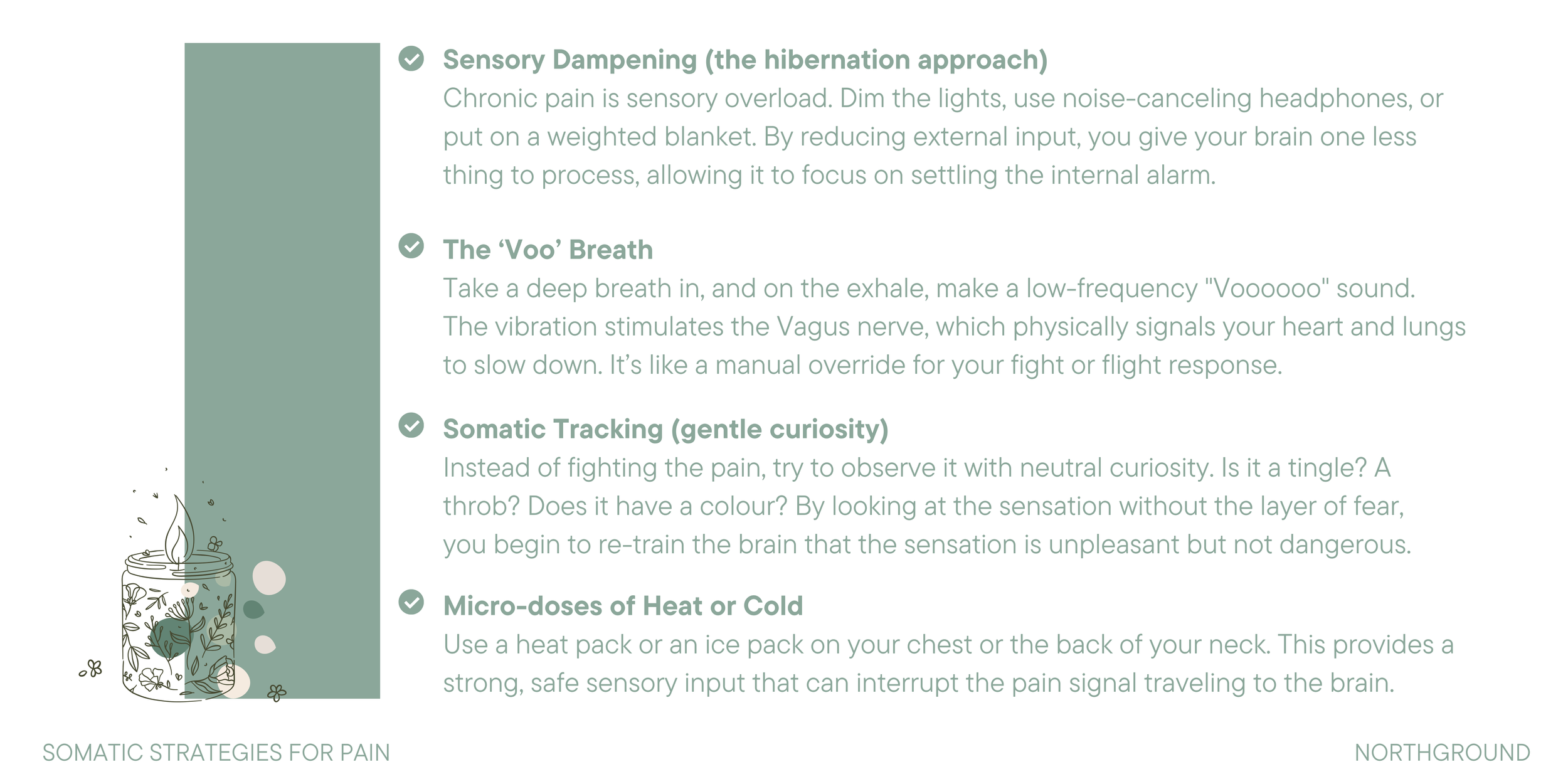
tip: save this image so that you have quick access to these strategies on your phone during a pain flare.
Ground First. Then Move North.
Pain can make your world feel very small. But by understanding that your nervous system is a dynamic, plastic system, we open the door to change. You aren't broken; your alarm is just set too high. Together, we can find the volume knob.
Ready to find your steady center?
If you are tired of carrying the load of chronic pain alone, let’s build your toolkit together.
Ready to start? Complete our New Client Intake Form here
Need more tools? Access the Northground Resource Hub for free downloads on Vagal Toning and ND Burnout recovery.