When your body feels like a warning
Understanding the Common Sense Model of Chronic Illness
If you live with chronic illness like POTS, Long COVID, Fibromyalgia, ME/CFS, or EDS, you know the feeling: your heart races for no reason, your muscles ache, or a flare seems to strike out of nowhere.
For many of us, the most painful part of chronic illness isn't just the symptoms—it’s the feeling that our body has become a stranger. You might have been told "it’s just stress," or felt the pressure to stay positive. But there is a biological reason why your body feels like it’s constantly on high alert.
The Brain’s "Common Sense" In psychology, we use a framework called the Common-Sense Model. It suggests that when we feel a physical sensation, our brain immediately tries to make sense of it. It asks: What is this? How long will it last? Is it dangerous?
But here is the catch: Your brain does this in two parallel tracks.
One track is your Thinking Brain (cognitive), trying to figure out the salt-to-water ratio, what you ate that set off joint pain or which doctor to call next.
The other track is your Autonomic Brain (emotional), which doesn't use words. It uses the language of Fight or Flight.
Diagram of Leventhal's Common-Sense Model of Illness showing parallel cognitive and emotional processing pathways
Why Your Nervous System Stays On.
In conditions like MCAS, Dysautonomia, or Chronic Fatigue, your body is dealing with real, physiological threats—inflammation, blood flow changes, or mast cell activity. Because these symptoms are unpredictable, your Autonomic Brain develops its own "common sense” explanation and action plan. It learns to stay hyper-vigilant to keep you safe.
Over time, your nervous system can get stuck in a loop where the sensation of a heart rate spike or a pain flare automatically triggers a danger signal. This isn't anxiety in the traditional sense; it is your body’s brilliant, but exhausted, attempt to protect you.
The Path to Grounding: Somatic Therapy
This is where somatic (body-based) therapy comes in. We can’t always think our way out of a nervous system flare. We have to speak the body's language.
By using gentle tools like EFT (Tapping), EMDR, or Vagal Toning, we aren't trying to cure the illness. Instead, we are teaching the Autonomic Brain a new piece of common sense: "I am feeling a symptom, but I am safe in this moment."
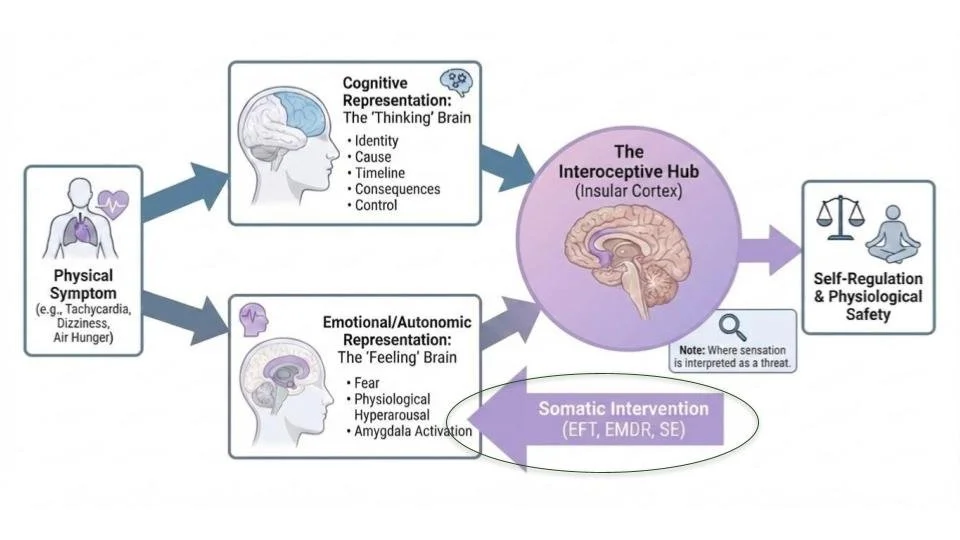
Diagram of where somatic interventions focus within the common sense model of illness.
How does this help?
We give the body a new common sense explanation and action plan - one that moves away from an activated nervous system (sympathetic) to a calm and regulated one (parasympathetic). It is in a regulated nervous system state that we can rest, digest and our medical management plan has a better chance of being effective.
When we lower the volume of the alarm, we give the body the quiet it needs to heal, to rest, and to finally feel like a home again.
At Northground, we believe in grounding first. Whether you are navigating POTS, EDS, or the complex fog of Long COVID, we are here to help you find your steady center. Reach out to book a telehealth consultation.